School safety has become an increasingly important topic for leadership teams, governors and site managers across the UK. While much of the conversation focuses on perimeter security and visitor management, internal door security plays an equally important role in safeguarding.
A school safety solution for internal doors is about reinforcing key areas in a practical and proportionate way which means understanding where vulnerabilities exist and taking sensible steps to strengthen them. In many cases, this involves reviewing how classroom and internal doors perform during a lockdown situation and whether additional reinforcement would improve resilience.
Why Internal Doors Matter In Schools
Most classrooms and offices are fitted with a standard school lock positioned at handle height. These locks are designed for daily access control, allowing staff to secure rooms during normal use and manage entry throughout the school day without difficulty. However, during a forced entry attempt, pressure is typically applied at mid height, with impact directed at the lock, latch and frame. While these components are perfectly suitable for everyday use, they’re not always designed to provide structural resistance under significant force.
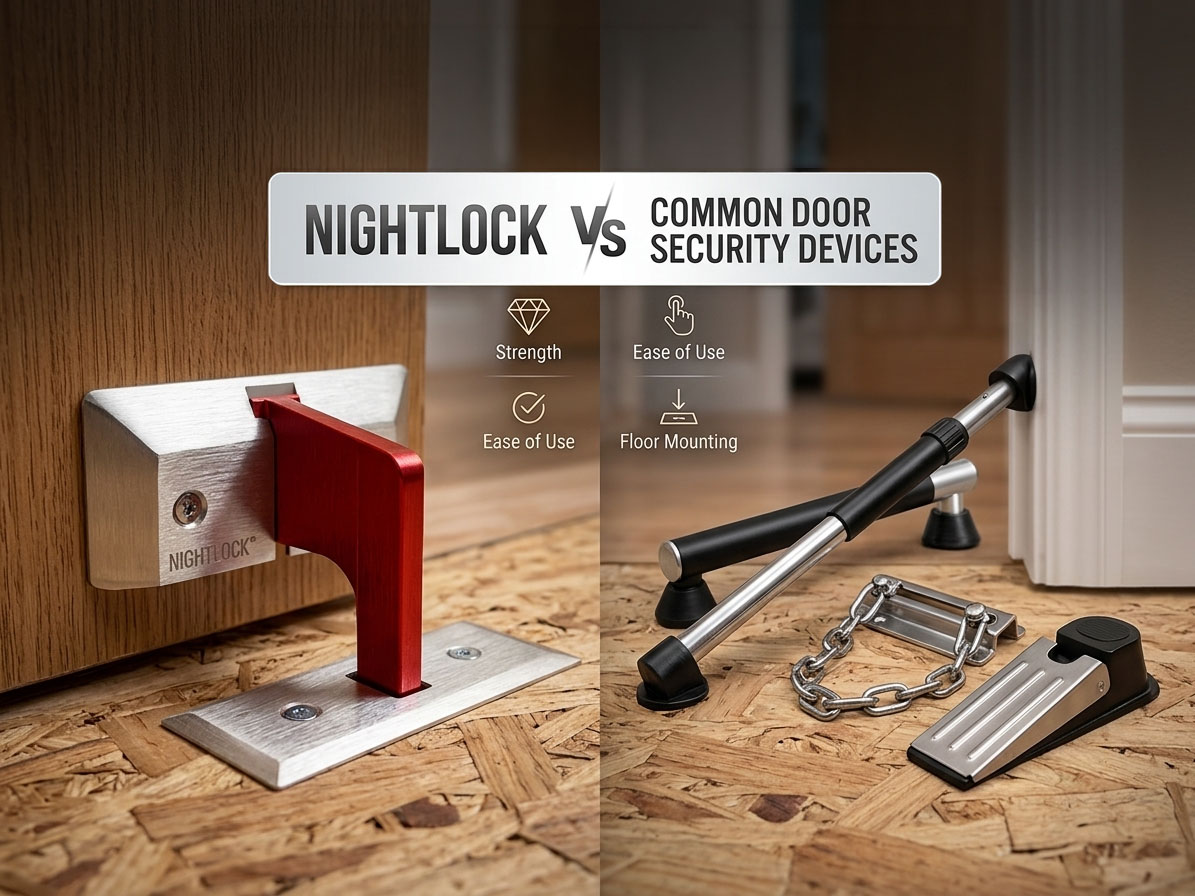
This is where internal door reinforcement, such as Nightlock, becomes relevant. Nightlock is easy to use and focuses on strengthening the weakest point of the door without disrupting daily teaching activity. It adds resilience while preserving the door’s normal function, so staff and pupils can go about their day as usual until the moment it is needed.
What Makes A Good School Safety Solution?
Before introducing any new classroom door security measure, schools should take a step back and assess what they actually need from it, factors such as:
- Does it work alongside the existing school lock
- Does it require complex electronics or ongoing maintenance
- Can it be deployed quickly if required
- Is it proportionate to the level of risk
- Can it be implemented consistently across multiple rooms
The most effective solutions tend to complement what is already in place rather than replace it entirely.
Nightlock, for example, is a floor anchored door security device that reinforces the base of an inward opening door. Instead of relying solely on the lock at handle height, the door benefits from a second point of resistance at floor level. This creates two independent points of reinforcement that work together to strengthen the door as a whole. The existing school lock continues to manage daily access, while Nightlock strengthens the structure of the door itself once engaged.
Supporting Lockdown Procedures
Lockdown procedures are now part of safeguarding planning in many schools, colleges and other education settings. These procedures focus on communication, staff roles and student safety, and are increasingly tested and refined through regular drills. Physical door reinforcement can support these plans in a meaningful way because Nightlock is a mechanical door security device that can be operated from inside the classroom, giving staff a direct and practical response option in the moment it matters most. It doesn’t rely on power, software or network systems but instead, simply reinforces the door when required, with no set up delay or risk of technical failure.
Importantly, it doesn’t interfere with fire safety responsibilities or everyday movement around the school. Any solution of this kind should always be assessed in line with existing building regulations and internal policies before it is rolled out.
Because the device is simple and discreet, there’s no fear factor behind the installation and usage.
Considering Martyn’s Law
With the introduction of Martyn’s Law, formally known as the Terrorism (Protection of Premises) Act 2025, organisations responsible for publicly accessible premises are being encouraged to review their preparedness and risk reduction measures.
For schools, this means demonstrating that practical steps have been considered where appropriate to the setting. Strengthening inward opening internal doors may well form part of that discussion. A visible and mechanical reinforcement option, such as Nightlock, can contribute to a layered security approach that also includes:
- Clear safeguarding policies
- Staff training
- Visitor management procedures
- Emergency response planning
A school safety solution should sit within this broader framework rather than operate in isolation.
Mechanical Versus Electronic Solutions
There are many products marketed as school safety solutions with some relying on electronic access systems, remote locking controls or alarm integration to achieve their aim. Electronic systems can certainly be effective for access control and monitoring, however, they still typically secure the door at handle height, managing entry without necessarily strengthening the structural base of the door itself.
By anchoring into the floor, Nightlock transfers force into the structural surface beneath the door, reducing reliance on the lock and frame alone. As a mechanical solution, Nightlock also avoids ongoing servicing requirements such as battery replacement, software updates or system testing. For many schools, this simplicity is a significant advantage, particularly for busy estates teams with limited resource.
Scalability Across Multiple Classrooms
Another important consideration is maintaining consistency across the school or wider trust. Many schools choose to prioritise reinforcing higher-risk areas first, such as classrooms furthest from reception or those with greater exposure to public access. The solution can then be rolled out in phases across additional classrooms or buildings, creating a consistent approach to door reinforcement.
Because Nightlock devices are cost-effective and straightforward to install, they can be deployed more quickly and easily than many alternative security solutions. They are suitable for reinforcing multiple inward-opening internal doors without the need for major structural alterations, allowing site managers and estates teams to standardise security measures across the estate in a controlled, practical, and manageable way.
Taking A Measured Approach
It’s important to remember that no single product solves every security challenge on its own. Any school safety solution for internal doors should complement existing measures, not replace them.
When reviewing options, leadership teams should ask themselves:
- Where are our most sensitive areas
- Are our classroom doors inward opening
- Do we rely on a single locking point
- Would additional reinforcement improve resilience
The answers will naturally differ from school to school, depending on layout, risk profile and existing provision. The key principle throughout is proportionality. Schools aren’t expected to turn into fortified environments but are expected to consider reasonable steps that improve safety without disrupting education or day to day school life. Strengthening internal doors with a practical reinforcement device such as Nightlock can be one of those steps.
It adds a second line of defence, supports lockdown planning and fits within a wider, layered safeguarding strategy. For schools reviewing internal door security in light of evolving expectations and Protect Duty considerations, understanding how solutions like Nightlock work is the first step towards making an informed and confident decision.