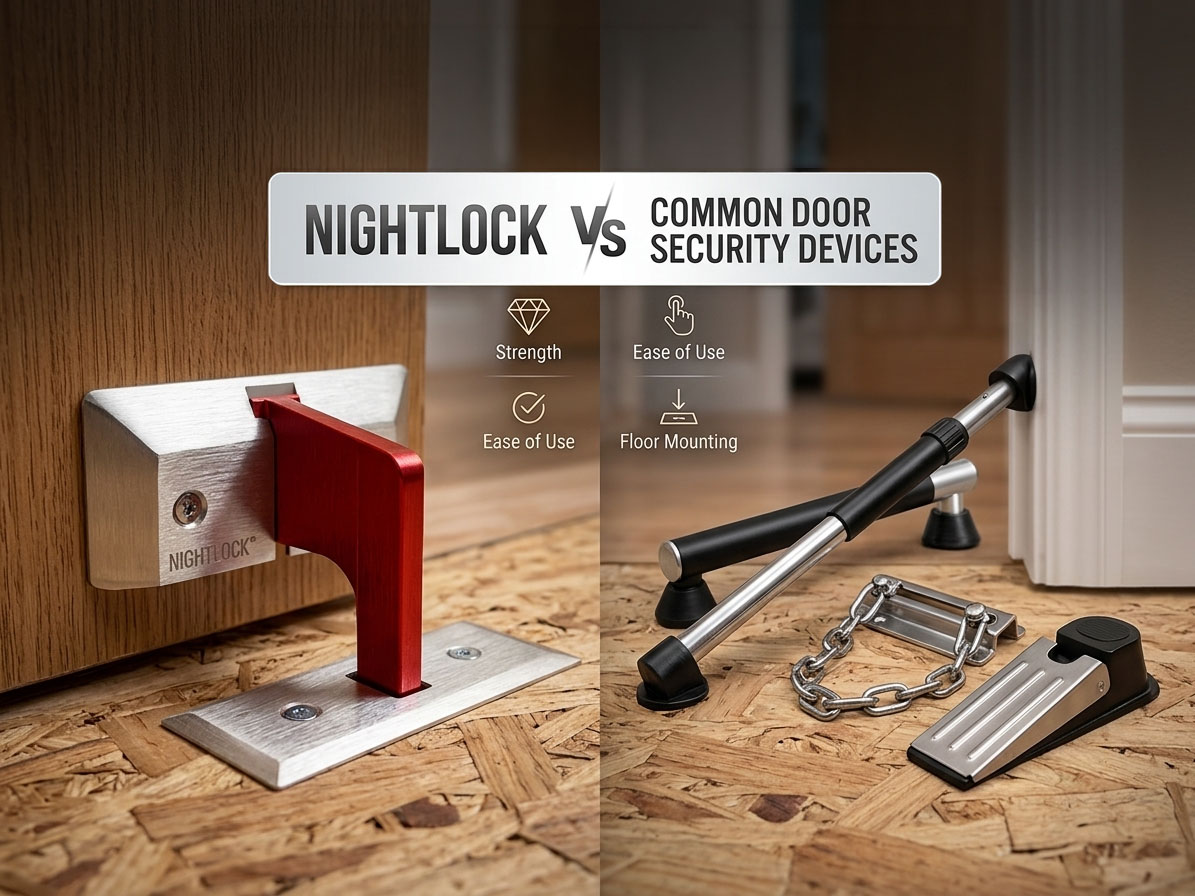
When comparing Nightlock with other door security devices, the key difference appears quickly. Most traditional locks secure a door at handle height. Nightlock reinforces it at the base.
That distinction changes how force is absorbed and where resistance is created.
Across schools, offices and publicly accessible buildings, internal doors are usually protected by a primary lock, sometimes supported by electronic access control or upgraded hardware. These systems manage entry effectively and are essential for daily use. However, when pressure is applied during a forced attempt, the stress is directed into the latch, strike plate and frame at mid height.
Nightlock introduces reinforcement at a completely different point. By anchoring into the structural floor, it creates a second resistance point lower down the door, which spreads force away from the lock area and into the floor itself.
Traditional Locks And Access Control Systems
Cylinder locks, mortice locks and multipoint systems are designed to control access. In commercial environments, these may sit alongside keypads, fob systems or integrated building controls. They perform their role well and are fundamental to building security.
However, a standard commercial or school lock secures the door at one main point. When impact occurs, the hardware and frame take the strain. Though robust for everyday use, they aren’t engineered specifically as structural reinforcement devices.
Nightlock doesn’t interfere with those systems. It sits independently at floor level and becomes active when engaged, giving the door two separate reinforcement points instead of one concentrated area of resistance.
Electronic Security And Detection Systems
Modern premises often rely on electronic door security devices to manage who can access certain areas and when. These systems are valuable for control, monitoring and audit trails. They add intelligence to a building’s security framework.
What they don’t do is change where physical resistance occurs.
Even with advanced access control, the physical locking point remains at handle height. In a forced entry situation, the structural behaviour of the door is largely unchanged.
Because Nightlock is mechanical, it doesn’t depend on power, software updates or network connectivity. There’s nothing to charge and nothing to programme. Once installed, it’s simply there when needed, reinforcing the door from a different angle without increasing technical complexity.
Hardware Reinforcements And Upgrades
Some door security devices focus on strengthening specific components such as strike plates, hinges or door edges. These upgrades improve durability and can increase resistance around the frame. They’re useful improvements, particularly where doors experience heavy daily use. Yet reinforcement still centres around the handle area and frame junction. Nightlock changes the load path entirely. By securing the base of an inward opening door to the structural floor beneath it, it redistributes force away from the latch and frame. Rather than reinforcing the same area further, it introduces strength in a new location.
Why Structural Anchoring Matters
The fundamental difference between Nightlock and many other door security devices lies in structural anchoring. Traditional systems hold the door closed, reinforcement hardware strengthens connection points and electronic systems manage access.
Nightlock anchors the door to the floor when engaged. That anchoring means force isn’t concentrated in one horizontal line across the lock and strike plate. Instead, resistance is created at both handle height and floor level. The result is a more balanced structural response without altering the door’s everyday function. It remains compatible with existing locks, access control systems and procedures. There’s no replacement required and no change to how staff or occupants use the door during normal operation.
Security In The Context Of Martyn’s Law
Security planning in publicly accessible premises is evolving. Martyn’s Law, formally known as the Terrorism (Protection of Premises) Act 2025, requires qualifying premises to consider appropriate and reasonably practicable measures to reduce vulnerability to terrorist attacks.
For many organisations, that means reviewing both operational procedures and physical security measures. Door security devices form part of that conversation. Access control, CCTV and alarm systems each contribute in different ways. Reinforcement devices strengthen physical barriers. The objective isn’t to rely on one measure but to build a layered approach that makes sense for the building and its use.
Nightlock fits within that layered framework by reinforcing inward opening internal doors without disrupting existing systems. It adds structural resistance while leaving access control arrangements intact.
Choosing The Right Combination
Every building presents different considerations. A small office may prioritise access control and secure storage rooms. A school may focus on classroom doors and safeguarding procedures. A healthcare facility may have specific operational requirements that influence product choice.
The decision rarely comes down to selecting one device over another. It’s about understanding how different door security devices interact and where reinforcement would provide meaningful benefit. Nightlock offers reinforcement at floor level, something most traditional locks and electronic systems don’t address directly. It operates independently, requires no electronic integration and supports a broader layered strategy. In that sense, the comparison isn’t about replacing other door security devices. It’s about recognising that structural anchoring adds a dimension of resistance that handle mounted systems alone can’t provide.